

Capitalism, socialism, and communism are three major economic systems that differ based on who owns property and how wealth is distributed.
- Citizens, not governments, own and run companies. They compete with other companies for business, decide which goods and services to provide, where to sell them and how much to charge.
- The profit motive drives investment and competition.
- Its defenders argue that government uses economic resources less efficiently than private enterprise and that capitalism spurs innovation.
- Critics point to income inequality; workers or consumers have little bargaining power.

- Its goal is to spread wealth more evenly and to treat all people fairly.
- Under a socialist system government, not individuals, control at least some businesses and property.
- In the U.S. most Democratic Socialists do not want the government to own the means of production. They advocate for a system focused on reducing extreme wealth inequality and corporate power.
- Is a political and economic system based on the equitable distribution of wealth among a nation’s citizens and common ownership of all property.
- It calls for the control of the means of production, such as manufacturing and agriculture, by the working class.
- Its ultimate goal is to achieve a classless society, at which point the state (or government) would “wither away.”1
- No country has reached this stage; in practice communist regimes have been highly centralized and run by dictatorships with little political freedoms.
Key Takeaways
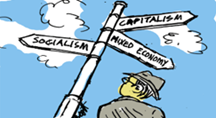
- Most countries have mixed systems that combine elements of capitalism and socialism.
- The U.S. is a capitalistic country but has socialistic elements. The U.S. regulates certain industries like financial markets, healthcare, utilities, environmental standards, labor laws, and consumer protections, subsidizes industries such as agriculture, transportation, and energy and has public welfare programs like Social Security and Medicare.
- Countries like Sweden or France which are viewed as socialist democracies still allow substantial private ownership of businesses in most sectors. Their market economies coexist with expanded social welfare programs funded via taxation.
- Socialist programs and policies can exist alongside capitalism in a society, which is less likely in a communist system.
- But even China, widely considered a communist country, has a thriving private sector.
- There is no purely capitalist, socialist or communist economy in the world today.
Examples of Socialist Policies in the U.S.
While the U.S. has remained fundamentally capitalist, many programs incorporate socialist
principles:
- Social Security — Provides retirement and disability benefits through a centralized, social insurance system funded by taxes.
- Medicare — Federal government-provided health insurance for the elderly.
- Medicaid— State government-provided health insurance for low-income residents
- Public Schools — Primary and secondary education funded by government at local, state, and federal levels.
- State Colleges and Universities —Higher education subsidized by state governments.
- U.S. Military — Collectively-owned defense force funded through taxes.
- Law Enforcement, Fire Departments, & Garbage Collection — Local government services available to all residents.
- Public Libraries — Local libraries available to all residents, funded by taxes.
- Public Parks — Recreational parks built and maintained by local governments.
- Public Broadcasting — Radio and TV stations funded by the government and donations, such as PBS and NPR.
- Interstate Highway System — Federally funded network of highways available for public use.
- Progressive Taxation — Higher earners pay a larger share of their income in taxes to fund social services,
- Federal Deposit Insurance Corporation (FDIC) — Government insurance on bank
deposits to protect savers. - Public Housing — Subsidized rental housing for low-income families and individuals.
- Food Stamps/SNAP — Federal food assistance vouchers for low-income households.
- Veterans Benefits & GI Bill— Variety of programs to support and compensate military veterans.
- Public investments in private companies—Since January 2025, the U.S. government has announced investments worth $27.7 billion across thirty-nine deals involving direct ownership.
Sources
Britannica: https://kids.britannica.com/kids/article/socialism/353787
Britannica: https://www.britannica.com/question/How-is-communism-different-from-socialism
Britannica: https://kids.britannica.com/kids/article/capitalism/352909
Canadian Encyclopedia: https://thecanadianencyclopedia.ca/en/article/capitalism-in-canada
CFR: https://www.cfr.org/articles/washingtons-growing-portfolio-tracking-u-s-government-investments
Investopedia: https://www.investopedia.com/ask/answers/020915/what-are-differences-between-capitalism-and-socialism.asp
Students of History: https://www.studentsofhistory.com/comparing-communism-capitalism
Time: https://time.com/4121126/bernie-sanders-democratic-socialism/
